Overview
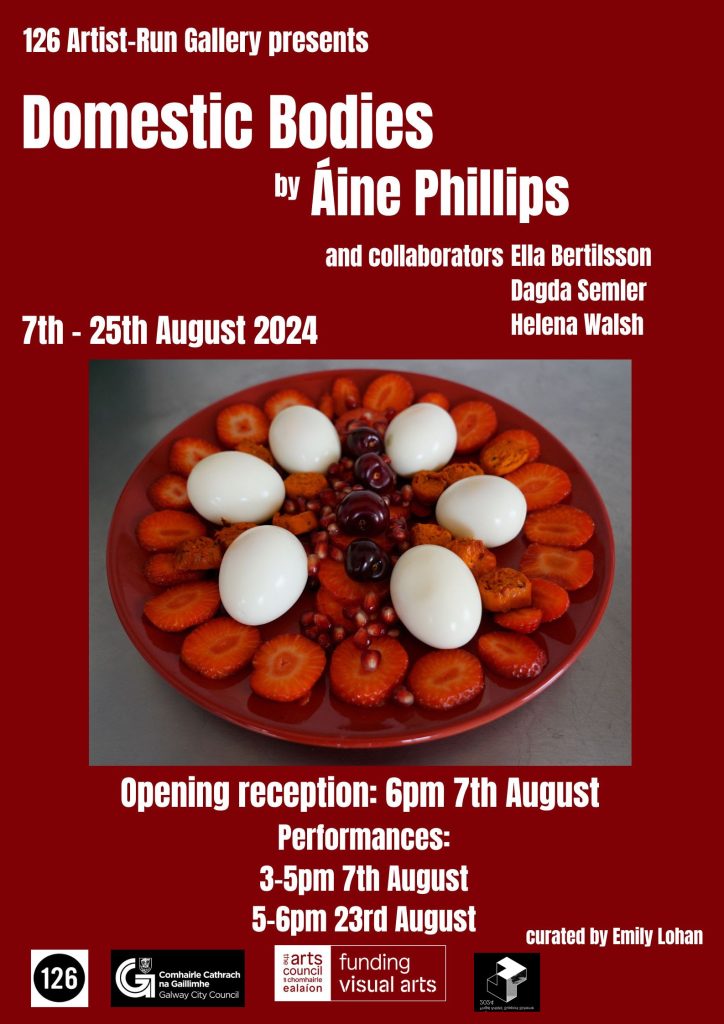
Domestic Bodies
Áine Phillips and collaborators Ella Bertilsson and Helena Walsh
Curated by Emily Lohan
Cinematography by Kevin Biderman and Vanessa Jordan
Editing by Connie Farrell
Sewing by Lizzy Dargie
__________________________________________________________
Domestic Bodies is an exhibition of performative installations by Áine Phillips and collaborators exploring themes of home, shelter and sustenance in the context of domestic space. These works aim to push the limits and potentials of domestic things to create metaphors for female subjectivity and experience. The exhibition as a whole confronts the pleasures, discontents and struggles of habitation: finding, keeping, and the meaning of home.
The exhibition is in three parts:
Embedded
3-5pm 7th August
Embedded is a collaborative performance installation with Ella Bertilsson addressing autonomy, security and safe resting places. It delves into the mysteries and transformations of sleep, highlighting the universal need for sanctuary.
Red Couch / Archeology
3-5pm 7th August
Performed by Dagda Semler Red Couch/Archeology is a performance installation from the Red Couch series. In the first two episodes the artist was subsumed into the underbelly of domesticity and was born again unscathed (Buttered Up 2016 and Escapology 2021). In this third scene she voluntarily dives back in again to uncover and excavate herstory.
Tender Morsels
5-6pm 23rd August
A collaboration with Helena Walsh, Tender Morsels is a performance film exploring female subjectivity, experience and defiance in relation to food and domestic space, serving as a metaphor for the female persona. A live performance of Tender Morsels took place in the gallery at the close of the exhibition.
_________________________________________________
Áine Phillips
Áine Phillips is an artist based in Galway who has been making installations, art films and performances since the late 80s. She creates live performance, installation and video works for multiple contexts: public space, social events, galleries, theatres, museums, biennales and film festivals. Her work incorporates socially engaged practice and she often works with communities of place and or interest, including many collaborations with Irish and international artists. Curating, writing and teaching are also part of her diverse practice. She holds a doctorate in performance art from the national College of Art and Design Dublin and is head of sculpture at Burren College of Art in County Clare. Her critically acclaimed edited volume Performance Art in Ireland: A History was published by Intellect Books/ LADA London in 2015. Her work is collected by the National Museum of Ireland and Galway Museum.
Ella Bertilsson
Ella Bertilsson is a multi-award winning visual artist based between Dublin and Callan. She is a recipient of a Project Studio Award at TBG+S 24/25 and is an Associate Artist with Museum of Everyone 23/24. Recently awarded The Art Council of Ireland’s Next Generation Award 23/24. Solo exhibitions; Forthcoming at The Horse ‘25, LIFE POND, Ballina Art Centre ‘24, A PEANUT WORMS DREAM, The Dock 23/24, and CUT THE CAKE WITH CLAWS, The Complex ‘22. Selected group exhibitions; Tides of Monumental Gestures, Luan Gallery with MOE ‘24, Endlessnessnessness, The Lab Gallery ’24 and Periodical Review 11, Pallas Projects/Studios ‘22.She has 1st class honours Fine Art Print (BA) and MFA; Art in The Digital World, both awarded from the National College of Art and Design IRE ‘09, ‘15 and Comparative Literature Studies and Creative Writing from Södertörn University SWE ’12.
Dagda Semler
Dagda Semler is an emerging theatre artist and enthusiastic performer with a degree in Drama and Theatre Studies from the University of Galway. Having grown up in the rural mountains between Leitrim and Sligo and now being settled in Galway, the history, culture and nature of the west of Ireland and how it has been developing across the years inspires Dagda’s creative output. Having previously been on tour with the organisation Active Consent as a lead actor with the educational play The Kinds Of Sex You Might Have In College, Dagda found a passion for using theatre as a way to educate audiences and strives to create drama which touches on issues of politics, race and sexuality with pockets of absurdist humour. Her hobbies outside of theatre include creating costumes, hosting dinner parties, knitting, camping and volunteering at festivals around the country during the summer season. In order to contact Dagda you can best reach her through her Instagram handle: @thrd_eye
Helena Walsh
Helena Walsh is an Irish Live Artist. Her practice explores the relations between gender, national identity and cultural histories. Helena works with time, liveness and the materiality of the body. Over the past 20 years Helena has performed widely in galleries, museums, theatres and non-traditional art spaces, including public sites. In 2013 she completed her PhD in the Department of Drama, Queen Mary University of London focussed on Live Art and femininity in post-conflict Ireland. Helena regularly presents and writes on feminist performance practice. She has published in collections focussed on live art, the performing arts and reproductive justice in an Irish context. She is a Senior Lecturer at the University of the Arts, London.
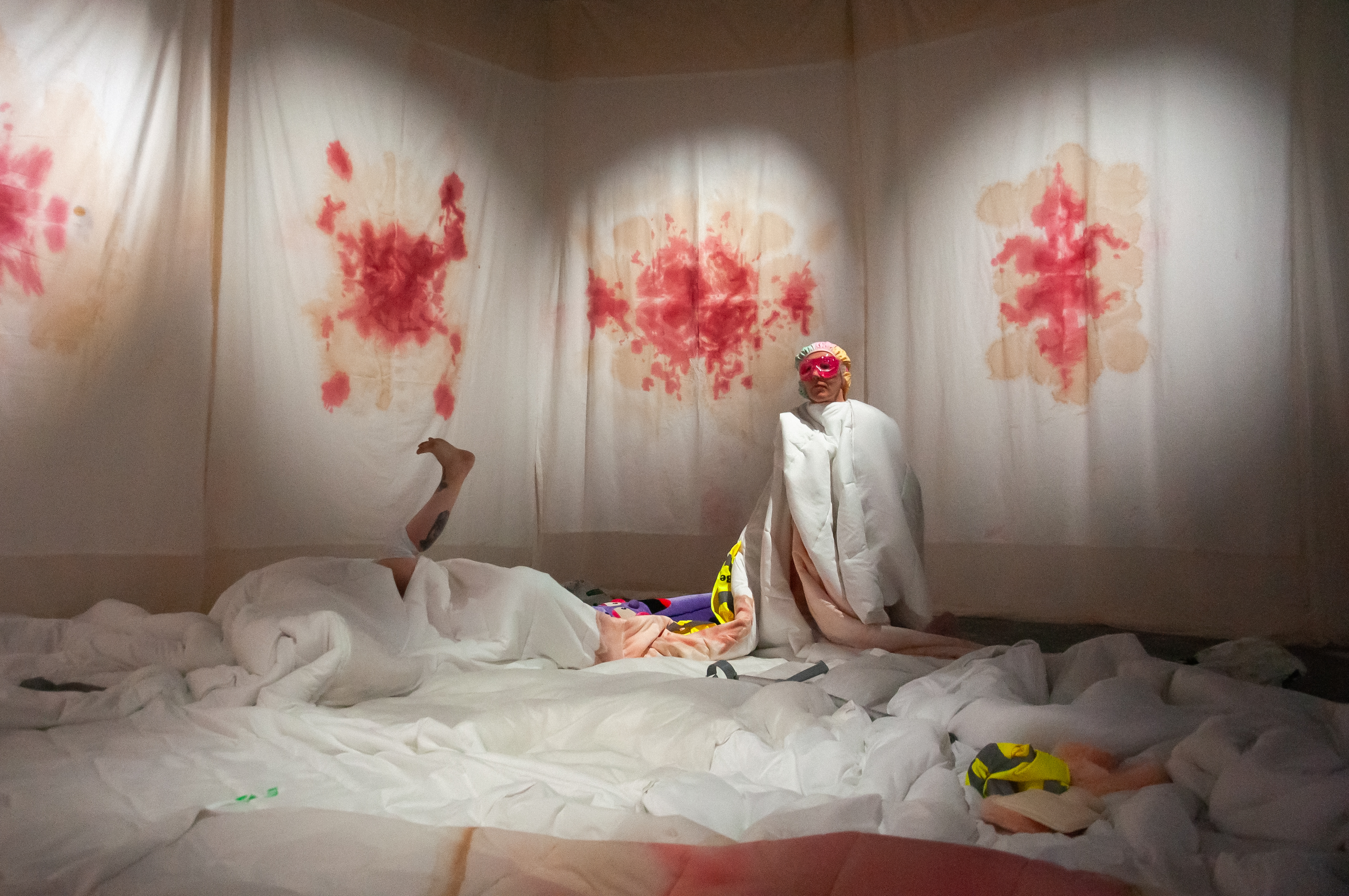
Embedded, by Áine Phillips and Ella Bertilsson, photographed by Manuela García
(Un)homely Bodies
An essay on Domestic Bodies, an exhibition by Áine Phillips and collaborators at 126 Artist-
Run Gallery Galway August 2024
by EL Putnam
Entering the gallery, I see eight spot lit white tapestries hanging on the walls. These linens
are stained with large red amorphous forms, appearing as blood stains with their layers of
crimson variance. As I come closer, I realise that they are stained with fruit, as the seeds
and entrails of flesh linger in the threads. The stains of the tapestries resonate with
Rorschach ink blot tests, though this test is not just in the content of the image, but pertains
to the staining material itself – what flesh made these marks: the fruiting bodies of humans
or plants?
These material traces provide insight into the multiple, slippery meanings accumulating
within Áine Phillips’s latest exhibition Domestic Bodies at the 126 Artist-Run Gallery in
Galway. Curated by Emily Lohan, the show features three works: the collaborative
performance installation Embedded (performed with Ella Bertilsson); Red
Couch/Archeology (performed by Dagda Semler); and Tender Morsels (film and live
performance created in collaboration with Helena Walsh). As a whole, the exhibit
encompasses an alive and throbbing gestural exchange that defamiliarises the domestic
sphere as a lived space, presenting it through a series of ambivalent uncanny, relational
encounters.
The gallery space has a sort of sacred ambiance, amplified by the sense of silent reverence
from the audience cautiously filling the room for the performances on the opening night.
On the ground is a giant white duvet, also stained with what is evocative of blood. The
oversized quality of the item brings St. Brigit’s cloak to my mind. According to Irish lore,
Brigit’s cloak grew to a miraculous size to cover acres of ground, claiming it for the building
of a church. A church is considered a spiritual home, a sanctuary for the soul. There is
slippage between home and sanctuary throughout the exhibition, though twisted from
influences of patriarchal organised religion to a femme-oriented, sensual semiotic register.
A red couch is parallel to the wall as I walk in. Since I anticipated staying the full duration of
the two-hour performance, I almost sat on it until I noticed toes peeking through a gap in
its middle. There is a print of an x-ray above the couch framed with a red ribbon that
conveys a double hip replacement, placed on display within this strange tableau of
domesticity.
My use of the term strange here is in reference to the exhibition’s overall sense of
uncanniness, as domestic bodies multiply and familiar everyday things are defamiliarised
through performance actions. The uncanny, or unheimlich in German, which translates to
“unhomely,” is a term used to describe scenarios that are familiar yet unfamiliar in a
manner that can be uncomfortable. As an aesthetic quality, it is associated with scenarios
when the familiar may intersect with the unfamiliar, and vice versa, cultivating
destabilizing situations that are affective but also revealing. Within this exhibit, the
uncanny is experienced through the ambivalent treatment of the domestic as both
sanctuary and suffocating, as meaning oscillates through performed gestures and material
exchanges.
As I sit down to witness Embedded, I begin to see movements underneath the massive
duvet. Subtle mounds begin to rise and fall within the lumpy mass of textile as the sounds
of slipping fabric fill the room. A recognisable tear of Velcro cuts through the near silence as
a hand slowly emerges from a newly formed hole. Movements continue as limbs slip in and
out, pushing through an increasing number of orifices emerging in this soft biomorphic
form. Bodies are presented in fragments, stretched out across the space of the floor. An
object is pushed through a hole—an empty hot water bottle. I am struck by this familiar
item of comfort, rendered useless when it is empty. It sits flaccid on the ground, made
abject from the unseen underworld beneath the fabric mass. A common item of care, it
becomes a literally empty symbol, tossed to the side in a futile gesture of comfort.
As time passes, the textile mass increases its vitality as Phillips and Bertilsson continue to
explore an unseen space, pushing through holes or excreting other things commonly
related with domestic care or comfort – toothbrushes, slippers, a sleeping mat. Other
objects emerge – empty plastic shopping bags, a suitcase – commonly seen clustered
around the sleeping places of those who are homeless. At this moment, the stains on the
duvets take on different meanings as they evoke the outdoor environment of rough
sleeping.
Just next to Embedded, the toes that I initially perceived as emerging from the red leather
couch grows into a pair of legs. Stopping at the pelvis, these legs transform the couch into a
Chimera of human and furniture, where they body rests at the liminal space of the vaginal
shaped opening; an almost supernatural image that is both amusing and disturbing. The
legs move irregularly, readjusting as they come to rest. At one stage, the knees part with the
feet coming together, revealing the vaginal gap of the sofa in a manner that mirrors the X-
ray hanging above it. It is an x-ray image of Phillips’s pelvis, displaying her double hip
replacement. Phillips has noted that she is unable to continue performing in this couch
since the surgeries. The couch has been a key aspect of previous works Buttered Up (2019)
and Escapology (2021). Within this current iteration, Red Couch / Archaeology, Phillips is
present through the x-ray above the couch, with Dagda Semler performing in her place.
While Phillips’s skeletal interior is made visible, Semler occupies the invisible mysterious
underworld of the red couch with only legs aloft, as it is not quite certain where the rest of
the body resides.
In the third work of the exhibition, the film Tender Morsels, two women are in a red-
decorated kitchen space and dining area, preparing a meal. One woman (Phillips) moves
through the kitchen, as close ups show her preparing yonic and phallic food objects. A
second woman (Helena Walsh), dressed in the same manner as the first woman, appears to
awkwardly fold herself unsuccessfully into the architecture and furnishings: her head
sticks in the microwave, she sits in the kitchen sink with her limbs extruding, she lies back
on the red couch as she holds her folded legs and stares at the viewer, she sits under the
glass tabletop with her hands pressed up against the glass. Walsh is present yet out of
place, as Phillips continues to make the meal without acknowledgement of her existence.
Phillips’s gestures of culinary preparation take on a certain violent sensuality, where the
innuendo of food items become more explicit while simultaneously reaffirming that she is
preparing cuisine. For instance, she holds a cucumber, framed in a manner that it takes on
the appearance of a phallus. However, as she begins to penetrate and cut with a knife along
the tip, this association becomes a visual double entendre as it oscillates between foodstuff
and sexual organ in gestures that are hilarious and violent.
Overladen trays of food continue to be prepared, cultivating a rich and colourful still life.
The film ends with both women seated at the table, as one pulls out the book of Judy
Chicago’s Dinner Party (1979); an iconic work that celebrates the often-undervalued
contributions of women artists. While Chicago’s installation is comprised of various dinner
settings of vulvar forms around a massive triangular table, with each setting referencing a
named woman artist, Phillips and Walsh’s film conveys the invisible labour that is involved
in preparing a dinner party, as they sit together to converse over the resulting abundance
of food. The domestic scene within this film is not merely celebratory, however, but
rendered ambivalent by means of Walsh’s spectral presence as Phillips’s doppelganger
throughout the process of preparation.
As noted, uncanniness is evoked throughout the exhibition, including the defamiliarizing of
domestic objects of comfort and care in Embedded, the supernatural tableau of Red Couch /
Archaeology, and the doppelgangers of Tender Morsels. As such, Phillips and her
collaborators unsettle the stability of the home in a manner that reveals the vulnerability of
bodies and relations that occupy it. These extend beyond the performers, as these aesthetic
encounters are affective, drawing the audience into shared relational experiences.
Over the duration of the opening night performances, which maintains a steady pace of
restraint and patient movements, the audience moves closer to ground. I find myself
getting lower and lower, even lying down at some points. I start to build kinaesthetic
empathy with the performers. I feel the coldness of the concrete against my flesh in my
attempts at maintaining a respectful stillness. I imagine heat accumulating under the
duvets: are these items of cosiness starting to smother in their bulk as the performances
progress? I become aware that items I have brought with me have begun to sprawl in the
space around me. I pull them in closer to me in gestures of self-conscious
acknowledgement of my clutter. Instead of physical fabric restricting my movements, as in
the performances I see unfolding before me, it is the shared social mannerisms and
decorum around personal space that create the invisible membranes that connect and
separate us. I make sure to keep my body in a shape so that it does not impede too much on
others’ capacity to view the actions. I become aware of these relations that are so familiar
to even become unnoticeable within social interactions that are now rendered strange, as I
self-consciously readjust to fit within this uncanny scenario.
The strength of Phillips’s exhibition resides in such dynamic complexities. Through
performed gestures, the meanings of objects morph as sensations transform.
Encompassing works that are both deeply personal yet relationally relevant, Domestic
Bodies presents an abundance of sensory and sensuous experiences that are wonderfully
uncanny and significantly revealing.
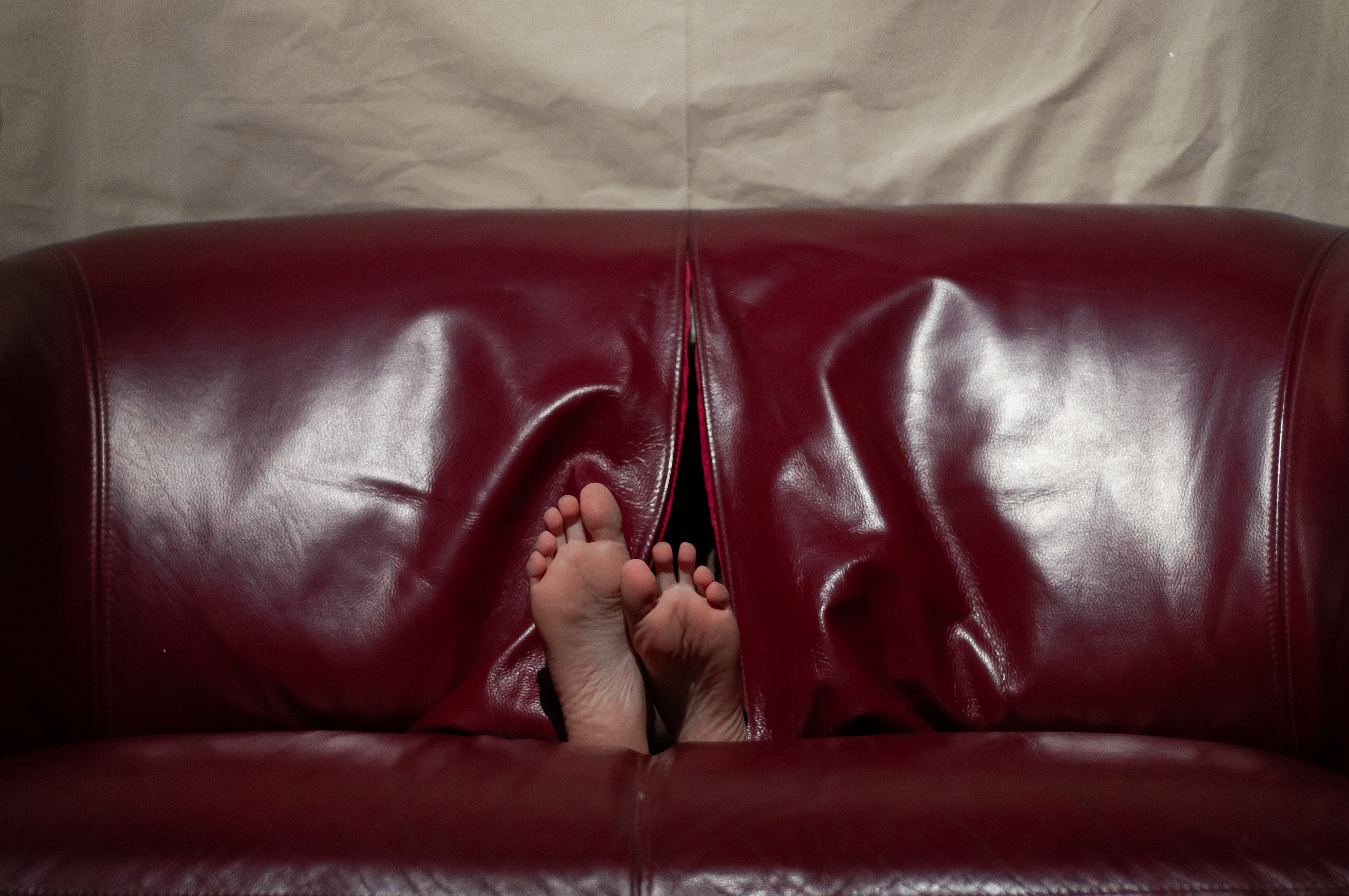
Red Couch/Archaeology, performed by Dagda Semler, photographed by Manuela García
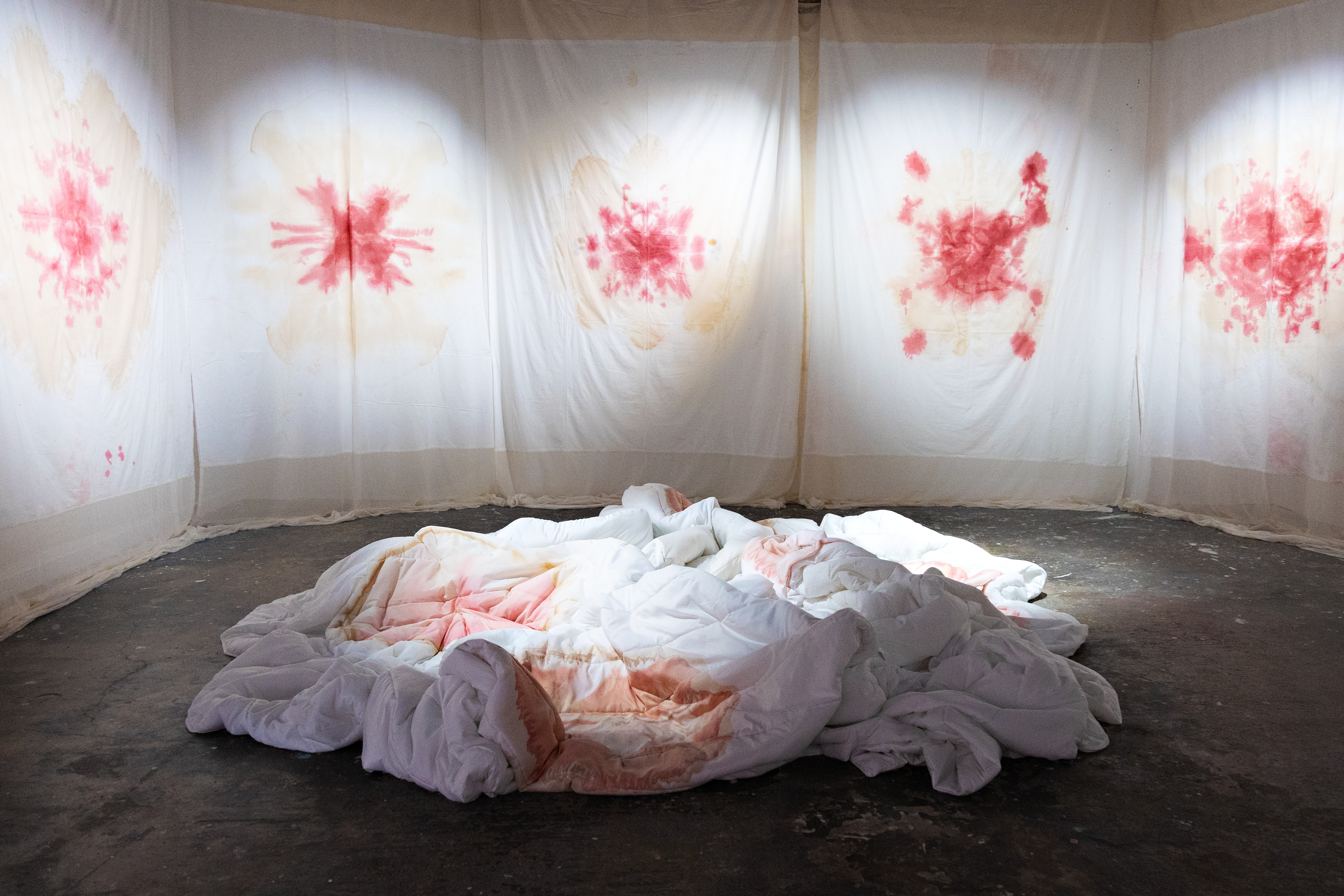
Embedded, by Áine Phillips and Ella Bertilsson, photographed by Manuela García
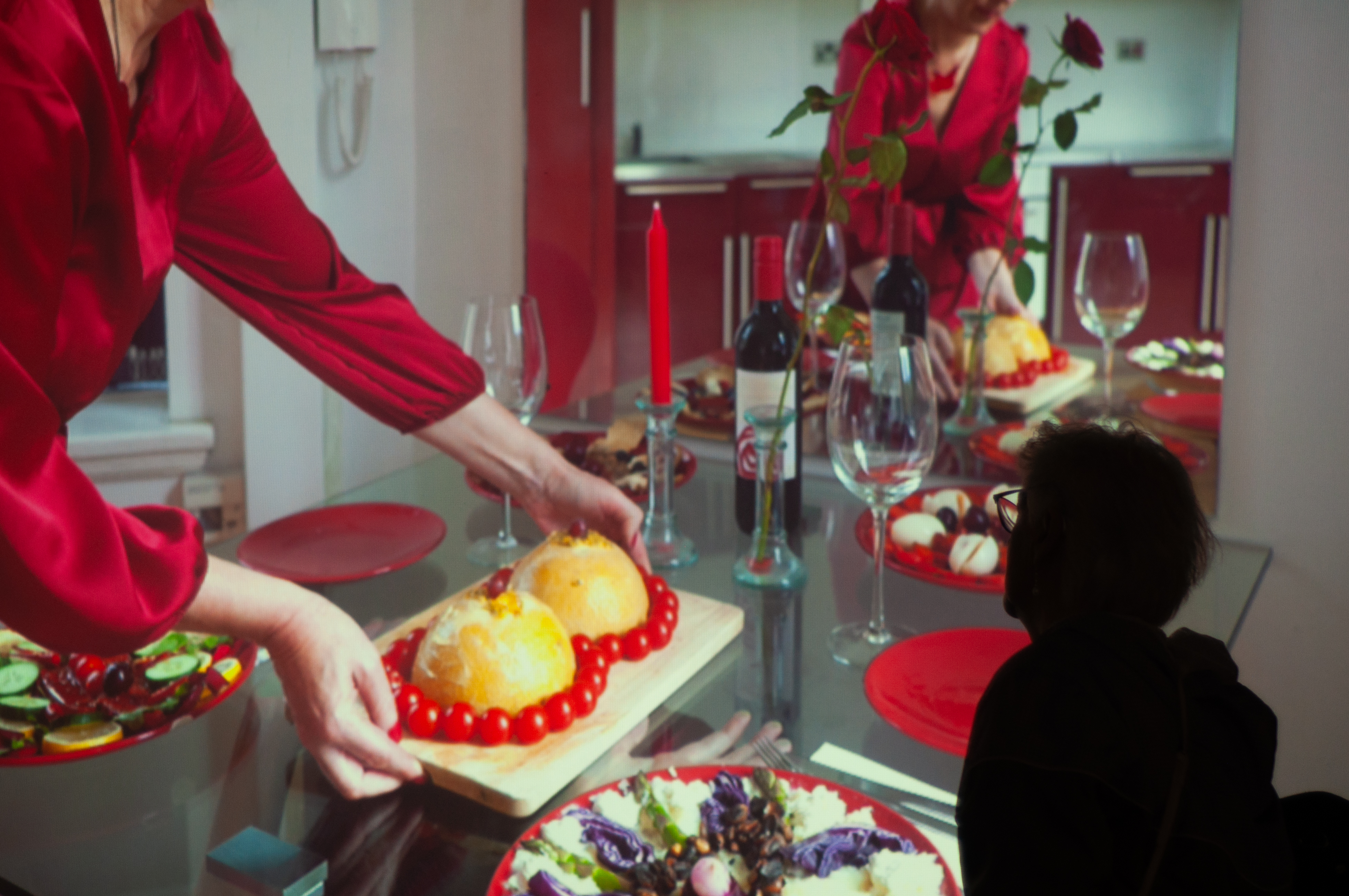
Tender Morsels, by Áine Phillips and Helena Walsh, cinematography by Kevin Biderman, edited by Connie Farrell
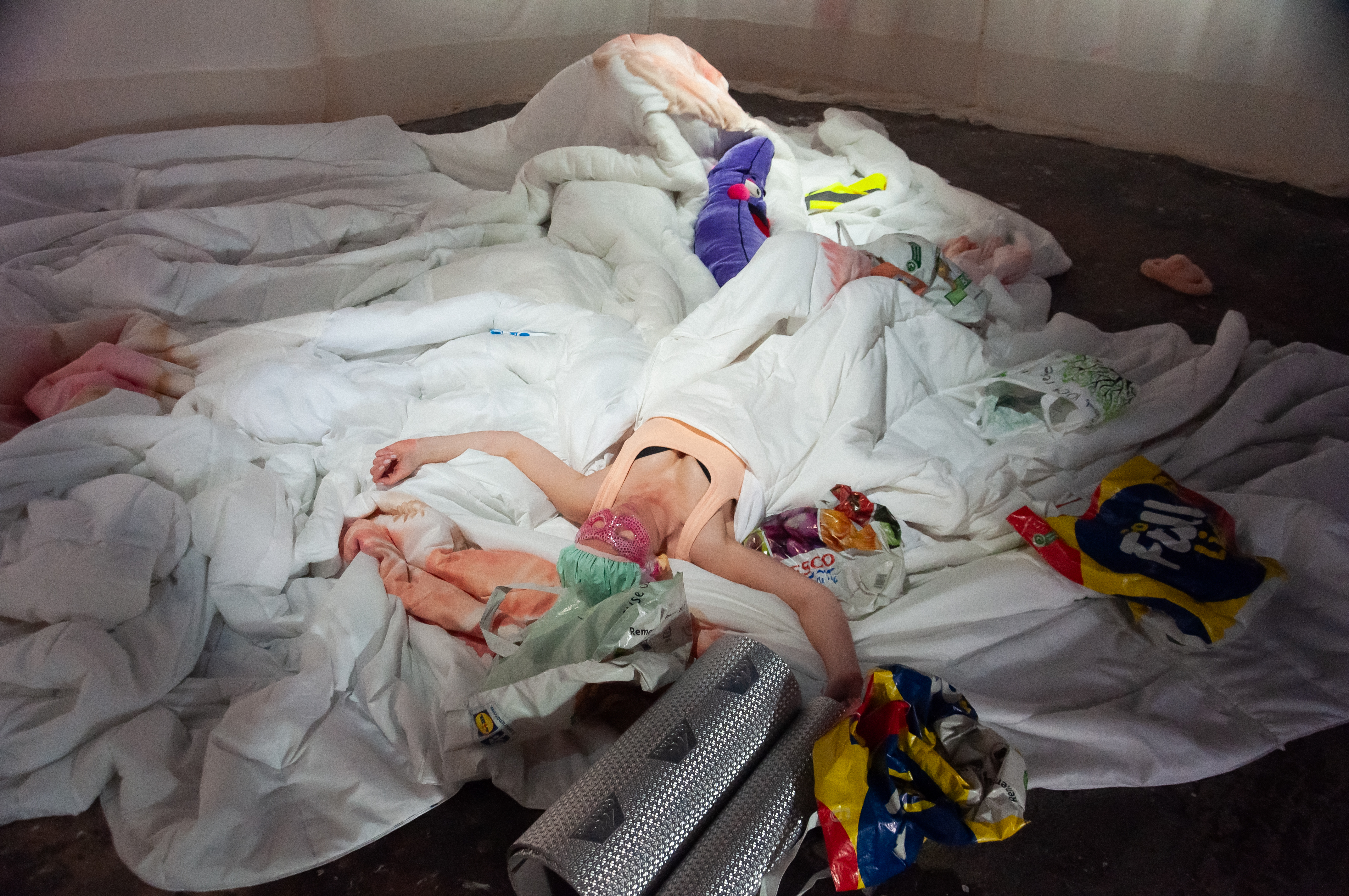
Embedded, by Áine Phillips and Ella Bertilsson, photographed by Manuela García
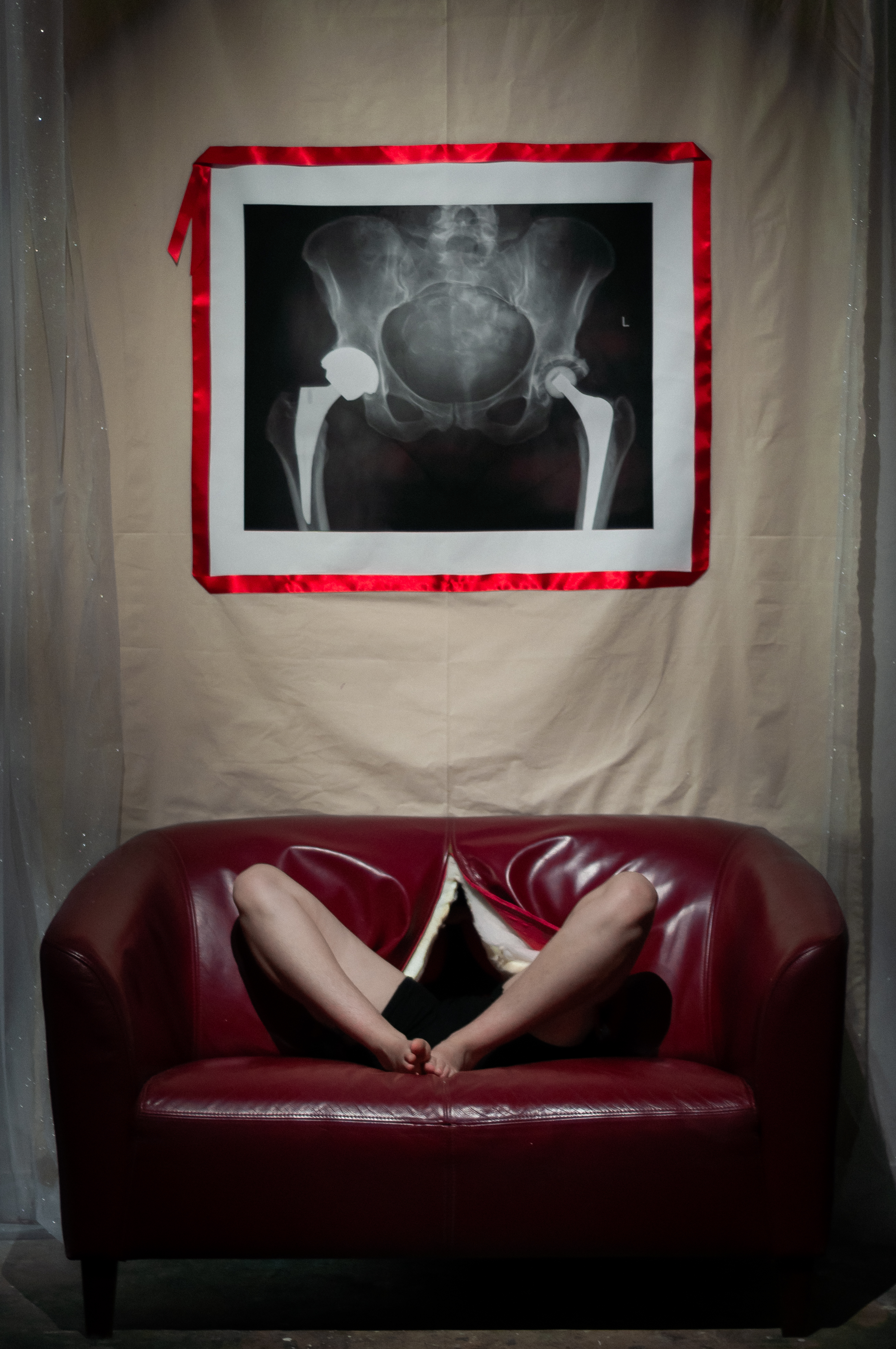
Red Couch/Archaeology, performed by Dagda Semler, photographed by Manuela García
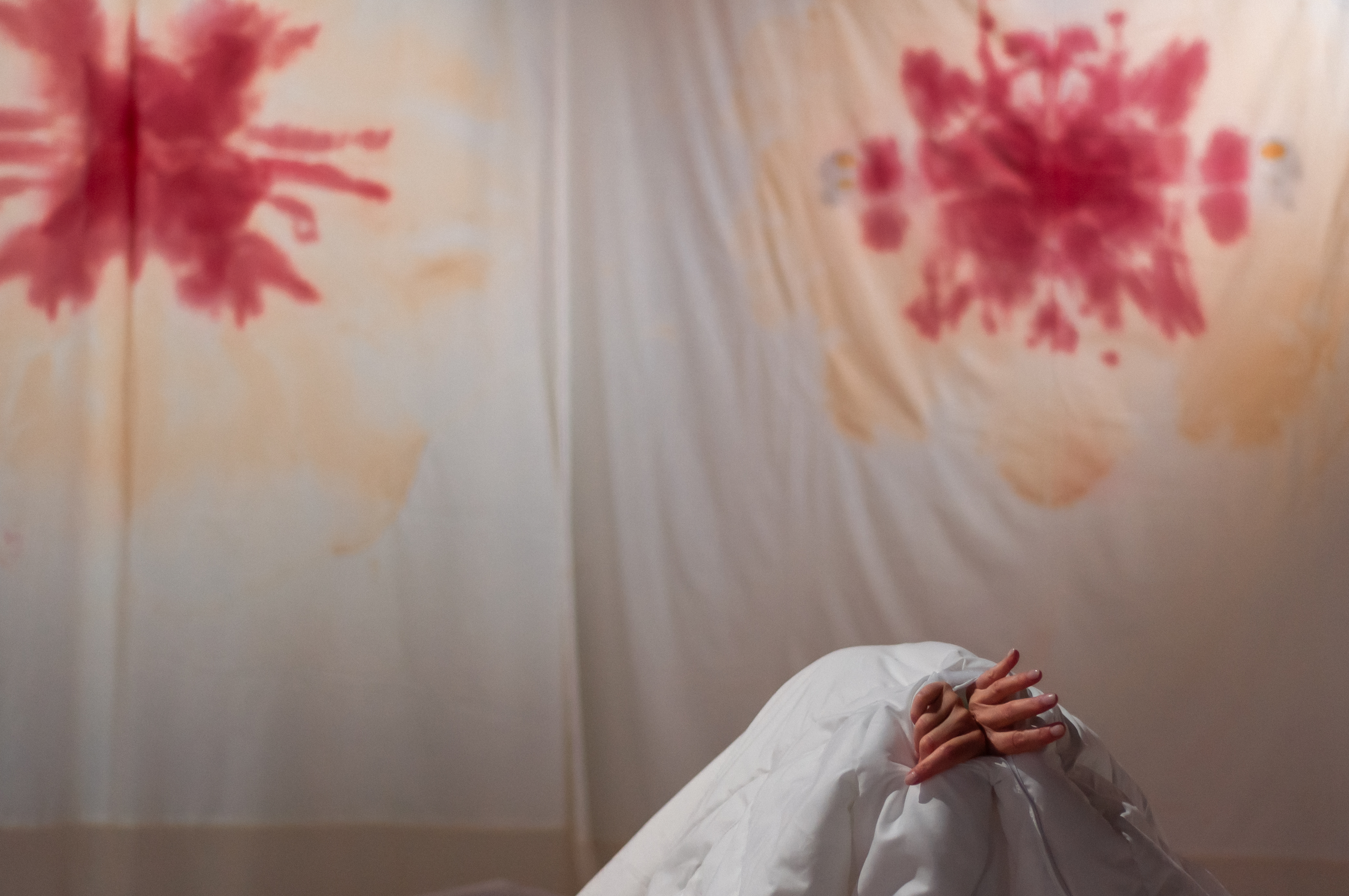
Embedded, by Áine Phillips and Ella Bertilsson, photographed by Manuela García